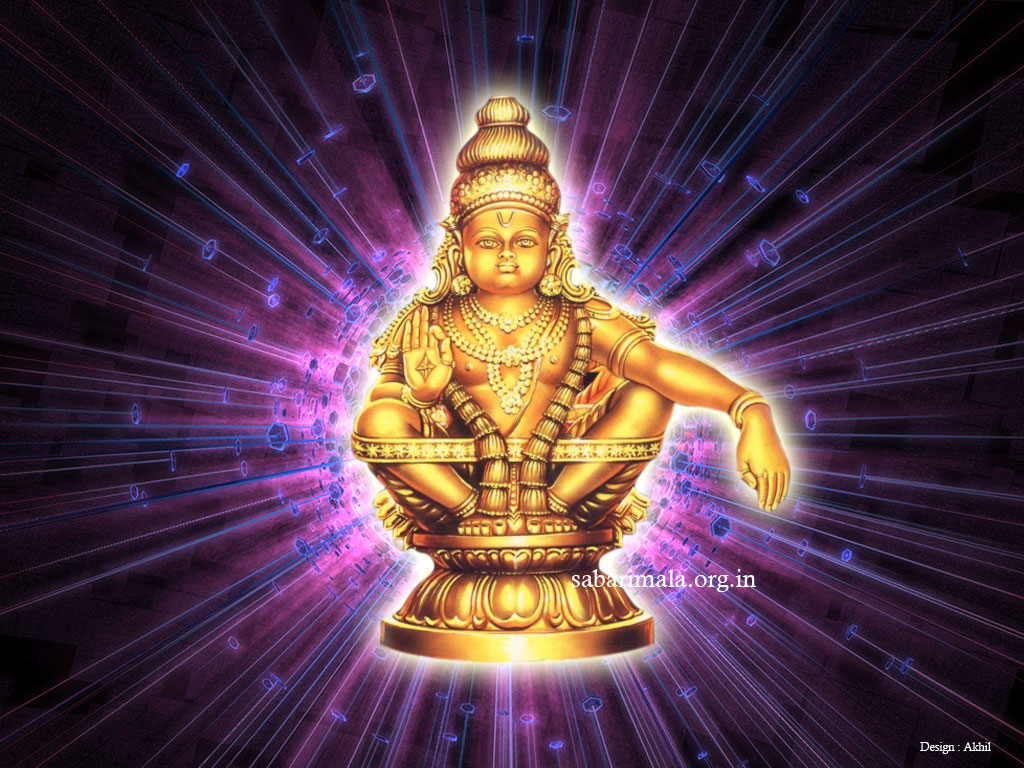
Sabarimala - History

Posted by CγвεгRat™ In , | 1 comments»


Sabarimala (Malayalam: ശബരിമല, Kannada: ಶಬರಿಮಲೆ , Tamil: சபரிமலை, Telugu: శబరిమల) is a pilgrimage centre in Kerala located in the Western Ghat mountain ranges of Kerala in Pathanamthitta District. Lord Ayyappan's temple is situated here in the midst of 18 hills. The area is in the Sahya ranges of Kerala. The temple is situated on a hilltop at an altitude of 914m/3000 ft above mean sea level, and is surrounded by mountains and dense forests. Temples exists in each of the hills surrounding Sabarimala. While functional and intact temples exist at many places in the surrounding areas like Nilackal, Kalaketi, and Karimala, remnants of old temples survive to this day on remaining hills. Sabarimala is believed to be the place where Ayyappan meditated after killing the powerful demon, Mahishi.

Sabarimala is one of the most visited piligrim centres in the world with an estimated 4.5 - 5 crores devotees coming every year. The world's second largest annual pilgrimage (after Hajj in Mecca) is reported to be to Sabarimala.

The pilgrimage to Sabarimala is a singular example of one where pilgrims, without consideration of caste, creed, position or social status, go with one mind and one mantra dreaming constantly of the darshan of the presiding deity at the Holy Sannidhanam. Vehicles can go up to Pamba River. However no girls/women between the age of 12-50 are allowed to visit this temple. This temple is very popular amongst all South Indians. The devotees are expected to follow a vratham(41-day penance), i.e. during this period they are to refrain from meat, fish, alcohol, tobacco, sex, using foul words, refrain from hair cut, shaving and should visit the local temples regularly and wear a special Mala( A garland made of Rudhraksha or Tulasi beads) and only black coloured dresses. Presently the conditions for Vratham are not as strict as it used to be earlier.


There is a place near the temple (east of Sannidhanam), dedicated to the Vavar, a Muslim who was the disciple of Ayyappan, called "Vavarunada". The temple is open for worship only during the days of Mandalapooja (November 15 to December 26), Makaravilakku (January 15) and Vishu (April 14), and the beginning of every month in the Malayalam calendar. Sabari was a devotee of Lord Rama. Her devotion is widely attributed to that of an ideal devotee. Lord Ayyappa wanted his pilgrims to honour the same attributes as that of Sabari and hence the hill on which the temple is situated is known as Sabarimala.


Vehicular traffic cannot go beyond Pampa, situated on the Pampa river valley and the last five kilometres to the shrine can be best reached by trekking. However, porter carried chairs (called as doli locally) are also available for the aged and handicapped pilgrims.

https://blogger.googleusercontent.com/img/b/R29vZ2xl/AVvXsEiVzv-PKVV2M-eVC20ESI1r_sVjwN1lM55-h6xzo_bGpvQZfkqHxrmFKhet1Il8M0sDJFJgg2xXw3O0N7XJOfsoDfgKGmESCeBTsOBbd960fPdvX-q24Xe9uXdNF-MOKfOgykqsBUDh1iw/s200/smala%5B1%5D.jpg

Thereafter, pilgrims have to follow a path approximately four kilometres up a steep hill. The path, now fully cemented, with shops and medical aid by the sides, used to be a mere trail through dense forest.

MAP

read more "Sabarimala - History"

Ayyappa Photos and Pictures – Sabarimala Ayyappa Temple Wallpapers

Posted by CγвεгRat™ In | 0 comments»
 http://www.nettomailbox.com/app/webroot/img/art_shapes/Lord-Ayyappa-big.jpg
There are hundreds of Lord Ayyappa Photos and Pictures of Lord Ayyappa on the internet. We thought that it would be nice to provide our readers with Sabarimala Ayyappa wallpapers as the holy Mandala Makaravilakku period is starting at the Sabarimala Ayyappa Temple.


The Sabarimala Ayyappa wallpapers for this post were selected from several websites and the images are copyrighted to respective owners we are only providing a link to respective websites. Some of the images were modified and created by us to give the look of a wallpaper.

Please click on the picture for a larger view of the image. Right click and use the save image option.


read more "Ayyappa Photos and Pictures – Sabarimala Ayyappa Temple Wallpapers"

Malayalam Panchangam

Posted by CγвεгRat™ In | 0 comments»


  Malayalam Panchangam 2009
                                                                                                                                            

read more "Malayalam Panchangam"

Ten Incarnations (Avatharams) of Lord Vishnu in Hinduism and the Evolution of Human civilization

Posted by CγвεгRat™ In | 2 comments»
The ten incarnations or ‘Dasa Avatara’ of Lord Vishnu is an extraordinary recording of the evolution of human life and advance in human civilization. In Hindu religion, the three main deities are Lord Brahma, Vishu and Shiva. Brahma creates, Vishnu protects and Shiva destroys - three faces of Mother Nature. Lord Vishnu descends on Earth to uphold dharma and to cleanse the Earth of evil. So far, Lord Vishnu has appeared nine times on Earth and the tenth, kalki, is expected.


The sequence of appearance of Lord Vishnu on Earth is in tune with the evolutionary theory. In fact, the ten incarnations of Lord Vishnu is an amazing recording of the advancement of human civilization. All this was recorded by Hindu sages thousands of years before Christ.


The first incarnation or avatar of Lord Vishnu was in the form of a fish and is known as ‘Matsya Avatar.’ It has now been confirmed by Science through various experiments that the first life forms evolved underwater.


The second incarnation of Lord Vishnu was in the form of a tortoise known as ‘Kurma Avatar.’ Tortoise is an amphibious creature capable of living both on land and in water and it indicates the moving of life form from underwater to surface of Earth.


The third incarnation of Lord Vishnu is the boar known as ‘Varaha Avatar’. Boar is a complete land animal and in this incarnation, life form has moved out of water and has adapted to land.


The fourth incarnation of Lord Vishnu is the half-man half-animal form known as ‘Narasimha Avatar.’ This incarnation starts the transformation from animal to human form.


The fifth incarnation of Lord Vishnu is the dwarf or pigmy sized human being known as the ‘Vamana avatar.’ A transition from the beastly form to human form and the development of intelligence.


The sixth incarnation of Lord Vishnu is the forest dweller known as ‘Parasuram.’ He has developed weapons and axe is his first weapon. Any sharp stone can be transformed into an axe and it also indicates the first settlement of humans in forests.


The seventh incarnation of Lord Vishnu is Lord Ram. He civilized and has developed more superior weapons like the bow and arrows. He has cleared the forests and developed small communities or villages. He is very vigilant and protects his villages and people.


The eight incarnation of Lord Vishnu is Lord Balarama. He is portrayed with the plough – the beginning of full-fledged cultivation. Human civilization has developed agriculture and is no longer depended on meat and forest for food. The beginning of agrarian economy.


The ninth incarnation of Lord Vishnu is Krishna. He represents the advancing human civilization. He is associated with cows, the beginning of domestication of animals and development of economy, which continues to the present day.


The tenth incarnation of Lord Vishnu is Kalki and is yet to arrive. He is believed to ride on a swift horse Devadatha and destroy the world. A clear indication that human beings will bring an end to life on earth. The numerous natural calamities created by human beings and the numerous nuclear weapons stored illustrates this.


After complete annihilation, Lord Vishnu alone floats on a pipal life - perhaps the last remaining life form. Thousands of years after the complete annihilation, life will begin again in water.
read more "Ten Incarnations (Avatharams) of Lord Vishnu in Hinduism and the Evolution of Human civilization"

Gomati Chakra – What is Gomti Chakra?

Posted by CγвεгRat™ In | 0 comments»
Gomati Chakra is a rare natural product, a form of shell stone, and is found in Gomti River in Dwarka, Gujarat in India. It is believed to bring luck and is used in spiritual and Tantric rituals. Gomati Chakra resembles the Sudarshan Chakra or Discus of Lord Krishna. It is used as a Yantra and also is used in worships.


It is believed that those people who possess Gomti Chakra will be blessed with money, good health and prosperity. It is also believed to protect children.


Some people bury Gomti Chakra in the foundation of buildings as it is believed to bless the residents with long life and prosperity.


Some people hang it in front of the house, shops and buildings for peace and prosperity.


In some regions, eleven Gomti Chakras are wrapped in a red cloth and placed in rice or wheat containers. This is for food security.

In some region, Gomti Chakra is worshipped on the Diwali day along with Goddess Lakshmi.


Gomti Chakra is available in pure form and also embedded along with jewelry. Some people wear it like a pendant.
read more "Gomati Chakra – What is Gomti Chakra?"

Trivandrum Attukal Pongala Festival – World’s Largest Congregation of Women

Posted by CγвεгRat™ In , | 0 comments»


A unique Hindu festival, Attukal Pongala is an annual congregation of more than a million women to offer Pongala to Attukal Devi, an incarnation of Shakti, the Mother Goddess in Hinduism. Pongala, or Ponkala, is an offering of boiled rice in earthern pot. Attukala Pongala has entered the Guinness Book of World Records as the largest gathering of women in the world. Attukal Temple is located in Trivandrum, Kerala, and the deity is popularly referred as Attukal Amma.


Attukal Pongala takes place during the Malayam month of Kumbham (February-March). Millions of women gather on the day to cook Pongala. They arrive from different parts of India and from around the world. Each woman makes a hearth and cooks Pongala. Women also cook sweet dishes made out of jaggery and rice powder like – mandaputtu, appam and therali. The cooking ritual begins around 10.30 in morning and is completed with the sprinkling of theertham (sacred water from the temple) around 1530 hrs.

Every Hindu festival has the backing of a myth and Attuka Devi’s is associated with the Shakti cult particularly the story of Kannaki.


Why do women gather in such large numbers? Most of the women make pongala to receive the blessings of Amma. Some do it for the welfare of her family. Some do it for favors received. Some do it for material gains. Some do it routinely. Each woman has a reason of her own. It is said that Attukal Amma never disappoints her devotees.


From a temple ritual, Attukal Pongala has now transformed into a celebration of womanhood. It is the celebration of Shakti – the one Mother, creator of all things or the primeval energy of the Universe that derives all divine and cosmic evolution. From her everything that exists was born to her all things will return. All animate and inanimate are her creations and she sustains them. She has a myriad forms - loving mother, girl, lover, sister, wife and the terrible that can annihilate. It is this Shakti, the great Mother goddess known by countless names, that is worshipped by millions of her representatives on the Earth on Attukal Pongala.
read more "Trivandrum Attukal Pongala Festival – World’s Largest Congregation of Women"

Attukal Devi Pictures - Attukal Amma Image

Posted by CγвεгRat™ In | 2 comments»


Pictures of Goddess Attukal Devi at Attukal Bhagavathy Temple, Trivandrum. Attukal Amma or Attukal Devi is the incarnation of Mother Goddess Parvati Devi. Attuakal Pongala 2009 is on March 10th.

Goddess Attukal Devi Picture - Attukal Amma


read more "Attukal Devi Pictures - Attukal Amma Image"

Kalpathy Ratholsavam 2009 at Palakkad, Kerala

Posted by CγвεгRat™ In , | 0 comments»


Kalpathy Ratholsavam or Kalpathi Ratholsavam is an annual chariot festival held at Sri Visalakshi Sametha Sri Viswanatha Swamy Temple (also known as Kalpathy Temple) in the Kalpathi village of Palakkad district in Kerala. The deities of the Kalpathy Viswanathaswamy Temple are Lord Shiva (Lord Viswanatha) and his consort Visalakshi, another name for Goddess Parvathi. One of the most remarkable festivals of Kerala, this week-long Palakkad Kalpathy Chariot Festival is celebrated during the month of November, every year. In 2009, Kalpathy Ratholsavam Festival is celebrated from 8th November 2009 to 16th November 2009. 

The Festival
Dedicated to Lord Viswanatha or Lord Shiva, the Kalpathy Car Festival is based on Vedic Tamil Brahmin culture. Vedic recitals are held daily and cultural programs are held in the evening. The recitals are believed to be over 700 years old. On the last three days, the temple chariots are ceremoniously taken in procession by large numbers of devotees through the streets. Major attraction of the festival is the three magnificent chariots, decorated with flowers and flags, in which one can feel the presence of the lord.

Fifth Day
On the fifth day night is the Rishabha Vahana procession. The deities from all the temples are taken out in beautifully adorned chariots and after their meeting at western end of new Kalpathy village ground at midnight, they disperse after two hours. The deities of Viswanathaswamy Temple are taken out and installed in the three cars, one for the main deity Viswanathaswamy and consort Goddess Parvathi; the second for Vigneshwara and third for Lord Subrahmaniya Swamy.

On the Final Day
The deities of Old Kalpathy Temple and Chathapuram Temple are taken in procession on the chariot and procession is made through all villages. By sun set, all the chariots return to the original place. Abhishekams (offering with rituals) are then performed to the deities who are decorated again and taken out on procession in floral palanquins during midnight. The palanquins then return to the temple at dawn on the first day of the Tamil month of Karthigai.

About Kalpathy Temple

The Viswanatha Swamy Temple, popularly known as Dakshin Kasi Viswanathaswamy Temple or Kalpathy Temple, is located on the banks of the Kalpathy River, a tributary of the Bharathapuzha River. Dating back to 1425 A.D., Kalpathy Viswanatha Swamy Temple is regarded as the oldest Shiva temple in Malabar and in Kerala. The village, Kalpathy, is also known as Dakshin Kasi or the ‘Varanasi of the South’. It is an early Tamil Brahmin settlement (agraharam) in the Palakkad District.
 
How to reach Kalpathy, Palakkad?

Kalpathy is about 3 km from Palakkad town.

By Air / Flight

C A Coimbatore Airport in Tamil Nadu (55 km) and Calicut International Airport (also known as Karipur Airport) (130 km), and Cochin International Airport at Nedumbassery, Kochi (140 km) are the nearest airports to reach Kalpathy, Palakkad.

By Rail / Railway Station

Palakkad Junction Railway Station (also known as Olavakkode Railway Station or Olavokot Railway Station) and Palakkad Town Railway Station are the nearest railway stations situated close to Kalpathy Viswanathaswamy Temple.

read more "Kalpathy Ratholsavam 2009 at Palakkad, Kerala"

Sankashti Chaturthi or Ganesh Sankatahara Chaturthi

Posted by CγвεгRat™ In | 0 comments»
[Lord+Ganesh++Picture+Hindu+Devotional+1.jpg]
Sankashti Chaturthi, also known as Sankashti Chaturti or Ganesh Sankatahara Chaturthi, is an auspicious day dedicated to Lord Ganesh, which falls every month in a Hindu calendar. Sankata literally means “problems or worries” and Hara means “removing or eliminating”, therefore Sankata Hara Chadurthi or Sankatahara Chadurthi is a day to invoke the blessings of Lord Ganesh to remove all problems in life.

Chaturthi falls on the fourth day after new moon and fourth day after full moon in the Hindu calendar. Sankatahara Chaturthi is the fourth day of the waning lunar phase after the full moon. Sankashti means liberation during difficult times and therefore observing this fast is believed to reduce problems and seek the blessings of Lord Ganesh. If Sankashti Chaturthi falls on Tuesday, it is known as Angaraki Chaturthi or Angaraka Chaturthi. Angaraki is the other name of Mangal or Kuja or Chevaai or Bhauma (planet Mars). In November 2009, the date of Ganesh Sankashti Chaturthi Vrat is on 5th November 2009.

How to perform Sankashti Chaturthi Puja & Vrat?

Devotees observe fast for the whole day and conclude it after moonrise. After taking a bath in the evening, Lord Ganesh is worshipped with Durva (a variety of very fine grass). Aarti is taken and the Naivedyam is offered to Lord Ganesha. Then Lord Moon is worshipped and the fast is broken by offering meal to Brahmin. Reciting prayers of Lord Ganesh form an important part of the Sankashti fast. Ganesh Gayatri, Ganesh Ashtothram Shatanamavali (108 Names), and Ganesh Atharvashirsha Avartan are the main mantras recited while observing Ganesha Sankatahara Chaturthi Vrata. Observing this fast brings happiness and fulfills one’s desires.
 
Worshipping Lord Chandra on Sankashti Chaturthi
On Sankashta Chaturthi, worship of Lord Chandra (Moon God) is considered auspicious. If you are not able to view the moon in the sky, an image of the moon can be drawn as a symbol. The moon is offered with sandalwood paste and flowers. Naivedya is also performed.
read more "Sankashti Chaturthi or Ganesh Sankatahara Chaturthi"